

There are no these values and those values, but universal human values that no one respects
If something has a head, it is easy to destroy. Just the head has to be cut and the job is done. Therefore, it is impossible to destroy Islam. It has no head, no human leadership, not like Vatican. If it was, it would have been cut off long ago because there is no social establishment, economic, financial system, power and distribution principle that is in force today and Islam would support.

It would be impossible! The response to this is that the doctrines must be polluted, and the opportunity for opening eyes by the principles of Islam must be removed. Since the Quran can only be understood by the ordinary people through interpretations, therefore the explanations are often distorted and teachings are deviated in the mainstream communications within and outside Muslim societies.
So, talking about Islamic countries is as meaningless as talking about Christian countries. None of them exist as far as classical teachings are concerned. There is politics here and there. Politics and not Islamic principles stand behind the Organization of the Islamic Cooperation (OIC), Gulf Cooperation Council (GCC) and all other organizations, similarly like in Europe, where Christian values are nothing more than slogan, including my little country. Such values do not exist. There are universal values that are nowhere respected. These values are the same everywhere and these are universally violated. Unity is perfect in this. So, we argue in vain, we grab each other's throats under the title of different religions, but those are only human aspects that are being confronted by ordinary people. By this I am not questioning faith, which is sacred and inviolable, but questioning the man who did that with the faith. Allah forgive me, but today Jesus and Mohammed (peace be upon them) are stuffed dummies who are used for putting into their mouths real or false thoughts that they may have told or may not. But unfortunately, the focus is not on the depth of thought, but on the shallowness of the purpose for which they are quoted. They are usually quoted for the contrary purpose than they have ever spoken for.
Let's look at two cases which, when put into practice, raise a thousand questions. Certainly, the practices that were originally laid down by any religion were driven by the best of intentions, no doubt. Thus, repentance and atonement served for a purely standing before the Lord. Good basement was given by 1. John, chapter 1. 8-10:
8. If we say, “We are without sin,” we deceive ourselves,* and the truth is not in us.
9. If we acknowledge our sins, he is faithful and just and will forgive our sins and cleanse us from every wrongdoing.
10. If we say, “We have not sinned,” we make him a liar, and his word is not in us.
We can see that the letter serves to awaken compunction. So, compunction was not always present in an instinctive society. However, 1. John 3:20 he writes: “In whatever our hearts condemn, for God is greater than our hearts and knows everything.”
At this point, however, the church helped to get the stage of atonement and opened up the opportunity for public confession. This is a long evolution that ends up with serving the sacrament of confession. Questions may arise here. Was it always the spirit the Apostle of John that led the church or politics? By becoming a power, it is easy to draw up a map on the thoughts and intentions of the citizens in the empire by waking up a sense of compunction then making them confess their sins, so that confession is a conscientious expectation. People have confessed their sins, and behold! The Church was always aware of the condition of believers without the use of CIA, KGB methods. People have denounced themselves for centuries, as they do today when posting on public net sites.
Confession is virtually a self-report when it is performed in front of irresponsible, incredible persons. We give news about our condition. But in the evolution of confession and self-revelation, we have come to lose our compunction. XII. Pope Pius on October 26, 1946 said in a radio message to the United States National Catechetical Congress in Boston: "The sin in the world today is that men have begun to lose the sense of sin." If we lost the sense of sin in the 20th century, what can the 21st bring? And if there is no compunction, where's the boundary of conscience? How can I take decision between sin and virtue? And that is the direction.
Similar things happened in our household. To mention just one, the evolution of jihad, which describes a similar arc as confession at the household of our Catholic brothers.
The word jihad appears frequently in the Quran with and without military connotations, often in the idiomatic expression "striving in the path of God (al-jihad fi sabil Allah)". Islamic jurists and other ulema of the classical era understood the obligation of jihad predominantly in a military sense.
They developed an elaborate set of rules pertaining to jihad, including prohibitions on harming those who are not engaged in combat. In the modern era, the notion of jihad has lost its jurisprudential relevance and instead given rise to an ideological and political discourse. While modernist Islamic scholars have emphasized defensive and non-military aspects of jihad:

Fight in the cause of Allah those who fight you, but do not transgress limits; for Allah loveth not transgressors. (Quran 2:190)
War is only permissible in self-defense and under well-defined limits. When undertaken, it must be realized with vigor, but not relentlessly, but only to restore peace and freedom for the worship of God. In any case strict limits must not be transgressed: women, children, old and infirm man should not be molested, nor trees and crops cut down, nor peace withheld when enemy comes to terms.
However, some Islamists have advanced aggressive interpretations that go beyond the classical theory.
Jihad is classified into inner ("greater") jihad, which involves a struggle against one's own base impulses, and external ("lesser") jihad, which is further subdivided into jihad of the pen/tongue (debate or persuasion) and jihad of the sword:

By the Soul, and the proportion and order given to it; (Quran 91:7)
Allah makes the soul, and gives it order, proportion, and relative perfection, in order to adapt it for the particular circumstances in which it has to live its life. Cf. 32:9. See also 2:117. He breathes into it an understanding of what is sin, impiety, wrong-doing and what is piety and right conduct, in the special circumstances in which it may be placed. This is the most precious gift of all to man, the faculty of distinguishing between right and wrong.

And its enlightenment as to its wrong and its right;- (Quran 91:8)

Truly he succeeds that purifies it, (Quran 91:9)
Ibn Rajab reported: Ibrahim ibn Abu Alqamah would say to people when they returned from an expedition:

You have come from the lesser jihad unto the greater jihad.
They said, “What is the greater jihad?” Ibrahim said:
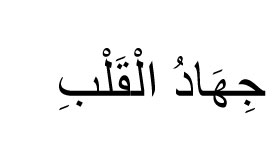
It is the jihad of the heart.
Source: Jami’ Al-Ulum wal-Hikam 19
In fact, the great Caliph Umar ibn Abdul Aziz likewise considered this to be the best and greatest jihad, even though he himself led armies against the enemies of Islam.

The one who strives in the way of Allah the Exalted is he who strives against his soul.
Source: Musnad Ahmad 23445, Grade: Sahih
Most Western writers consider external jihad to have primacy over inner jihad in the Islamic tradition, while much of contemporary Muslim opinion favors the opposite view. Gallup analysis of a large survey reveals considerable nuance in the conceptions of jihad held by Muslims around the world.
It is noticeable however, that none of the classical literature refers to the "Holy War," which could be preached in an offensive manner. It is a manipulated practice that took us very far from the original spirit of jihad. We can all ask today, after we have better analyzed the roots of our faith: what the hell are we following today? Or asking it more precisely, who the hell are we following? For whom should I honestly uncover my soul and divulge my innermost secrets? For a criminal organization?
And another criminal association encourages me not to be peaceful? Should I fight for the earthly interests of dirty minds and not for the purity of my soul, for the protection of my family and my community? Back to the title: there are not these values and those values, but universal human values that no one respects. We are obliged to violate the divine values the moment when hate is smuggled into us.
The content above does not exclude that there are individuals, priests, sheikhs who are decent, committed to their conscience, and most of the time they suffer of the abuse by the organization and finally become victims.


