
Methodology
Law is not about combats of emotions. It is a sort of regulation of human relations related in a particular place and time. Even law goes thru an evolution and as a result it develops. Finally, different schools of jurisprudence are formed. Scholars reevaluate the systems which were followed and they abolish what is outdated and they keep the rest or harmonize it to the actual legal environment.

ATTITUDE RELATED TO LEGAL SYSTEMS MADE BY HUMANS
The source of Islamic Law is the Holy Quran. Sharia means not simply Islamic Law. It means Order of Divine Legitimacy. The words of Quran are unchanged for 1400 years and they are applicable in every age and place. Therefore, Quran defines general principles and never specifies them. Doctrines (Aqida) and Sharia represent the two main parts of the Quran. This study deals exclusively with the Sharia.
In order to comprehend the application of Islamic jurisdiction it is inevitable to avoid human made law references. Also, canon laws followed by other religions should not have taken as references due to the fact that those have already lost their divine character and have become human made creations. Even in case of Islam the applied law is human made however Islamic scholars deduct regulations from the word of Allah while in case of other religions their Holy Scriptures in their actual form have lost their divine origin. Those laws are human made regulations deducted from human made scriptures. In the course of Islamic deductive analogy Words of Allah are taken as bases (Qiyas). In this case the object of analyses is the way of Prophet (PBUH) what he followed when he converted the words of Quran into practice in his conducts, teachings and judgements. However the Prophet lived 1400 years ago in the Arabian Peninsula so his religious practice regarding Sharia cannot be followed the same way. Therefore Sharia adaptation or harmonization has to be realized in every ages and places. The logic of adaptation and transplantation has firm regulations. The methodology of Deductive Analogy beside the judgement itself puts in focus the intentions behind the judgements.
Ego and Spirit. Deductive Analogy is an objective science but every objectivity can become subjective in the hands of human beings. In secular culture terminologies like body and spirit are clear. In Islam the case is more complicated. Regarding body Islam has the same understanding like western world however spirit means different. In man works two very strong motivation: Ego (Nafs, نفس )and Spirit.
(Ruh, روح ).Ego wants always to prevail in order to subjugate the spirit. Ego is manipulated by Satan while spirit is the gift of God. Ego dies with the body however spirit is reckoned with those sins what was forced on it by ego. Our heart and mind is considered as battlefield of these two. In order to purify our spirit we have to gain victory over our ego by our own free will. The progress of human ego goes thru three phases:
- Ordering ego (nafs al-amara). In this phase our ego has no control at all. It works as an instinct and does what it wants. Desires dominate over mind and spirit.
- Blaming ego (nafs al-la’ama). Control comes in operation and man starts to choose between good and bad. In the Christian culture this is the conscience.
- Soul in complete rest and satisfaction (nafs al-mutma’inna). Ego disappears so we call it soul what has found the way to Allah. Spirit is pure and in complete satisfaction.
What are those events which can turn ego against Allah and humanity? Which are the main sins in Islam what can support ego and pollute spirit? What are the factors what one has to avoid in course of legislation and jurisdiction? What are the motives which can drive Deductive Analogy to the wrong direction? In case we can gain victory over the below five main sins our legislative activity, jurisprudence and jurisdiction will pass on the righty way:
- Fitna: temptation, perturbation, intrigue, disruption.
- Nifaq: hypocrisy
- Kufr: disbelief
- Shirk: idolatry, placing a person or ideology at God’s level
- Baghi: greedy desire in order to acquire worldly issues
The above main sins will be clarified and their legal concern will be explained later.
Sharia is Order of Divine Legitimacy deducted from the word of God therefore it doesn’t accept other law systems made by human. It doesn’t mean that Sharia cannot follow human legislation! In case the laws are made by the legislation of the majority (like in EU countries), Islam supports their application in case those are not violating the basic principles and doctrines of Islam.

Those who hearken to their Lord, and establish regular Prayer; who (conduct) their affairs by mutual Consultation (Shura); who spend out of what We bestow on them for Sustenance (Quran 42:38)
In this case Shura means General Assembly or Parliament. Muslims are also under the force of laws taken by these forms of legislations. Even if regulations violate the practice of Islam, Muslims have no right to establish parallel Islamic jurisdiction what may disrupt internal order of a particular region. In this case Muslims have right only for migration so they can leave for places where they can practice Islam freely.

When angels take the souls of those who die in sin against their souls, they say: "In what (plight) Were ye?" They reply: "Weak and oppressed Were we in the earth." They say: "Was not the earth of Allah spacious enough for you to move yourselves away (From evil)?" Such men will find their abode in Hell,- What an evil refuge! (Quran 4:97)
If we accept the fact that Quran is the word of Allah (and this is a basic principle for every Muslim) we have also accept that even the law deducted from the word of God is divine law and it prevails over secular regulations including the burden of human mistakes. This statement is true only in case the deducted regulations from Quran are worked out by following the prescribed methodology and human contaminations are not polluting the law-making process as it happens many times.
The Fatiha Sura gives strict instruction for going far from human dimension and for being independent from that level. This is the very first Sura and it is part of every daily prayer:
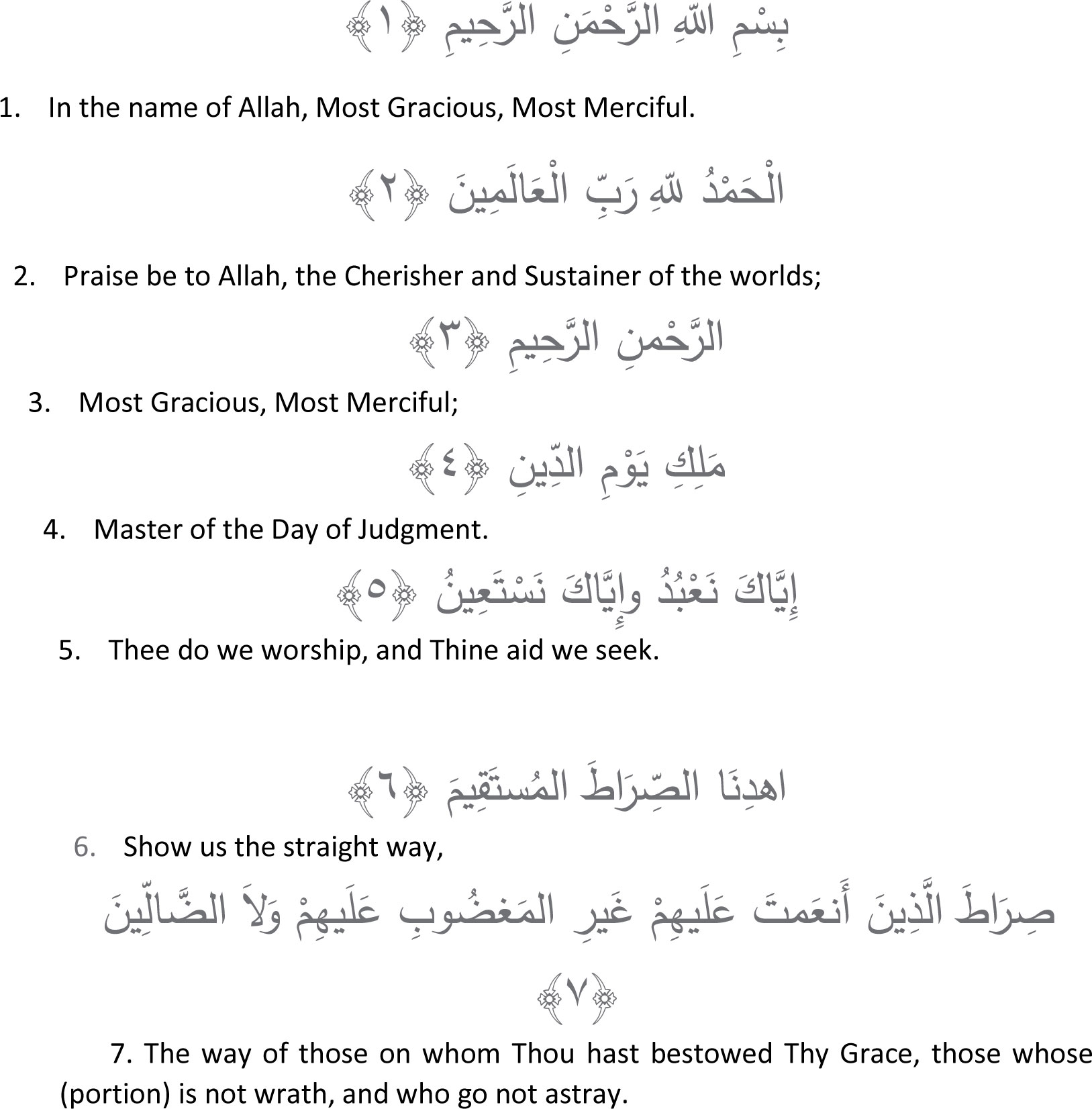
The first four verses call for praising God. The fifth is a sort of bargain or deal. In exchange of prayer a divine shelter is the payment. The last two verses describe the obligation of Allah for those who praise Him and move apart from the human context. Their being links them to the entire universe and not to this world only. This is the straight path leading to Him and to the Real Mercy. In order to get this phase one has to leave behind those who deserve the wrath of God. They are those who have willingly not followed the Divine Law or even transliterated them. One also has to leave behind those who changed the Divine law by their foolishness unwillingly and have got astray.
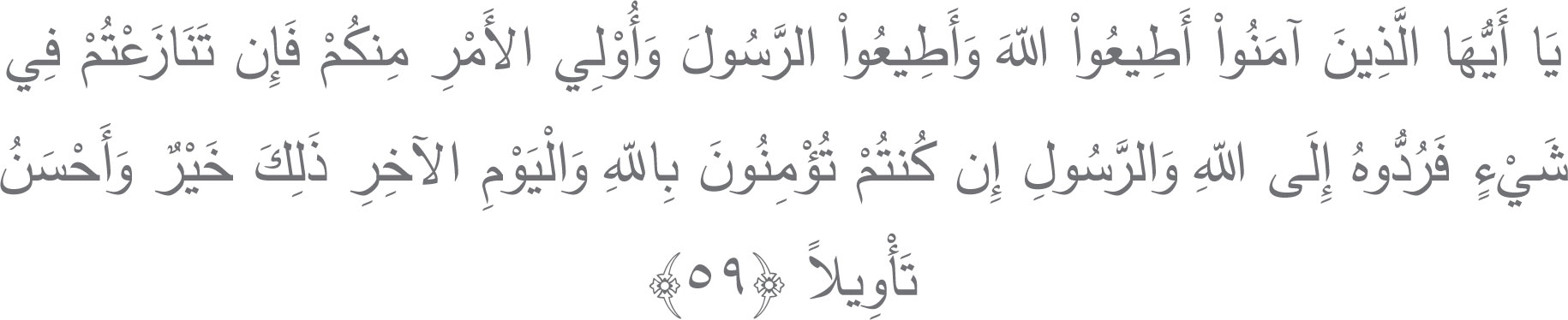
O ye who believe! Obey Allah, and obey the Messenger, and those charged with authority among you. If ye differ in anything among yourselves, refer it to Allah and His Messenger, if ye do believe in Allah and the Last Day: That is best, and most suitable for final determination. (Quran 4:59)
Putting trust in Allah means putting trust in the words of Quran, the highest quality of Law. If Quran doesn’t give relevant judgement for a particular situation the second step is to analyze the practice of the Prophet (PBUH) when he applied Law of God and transformed it into earthly jurisdiction. If even the second step doesn’t give relevant solution Qiyas comes using deductive analogy. It means that dignities, scholars, faqihs (ulemas of Sharia) conduct deduction based on the existing analogies and come to conclusions related to the actual age and place. This conclusion further represents as main condition of the actual jurisprudence. In order to start deduction of analogies they need Source of Law what represents as the object of deduction. Source of Law is the contemporary Tafsir, explanation of the Holy Quran as basic document of Qiyas. For example, commentaries of Quran from the 9th century made in Egypt cannot be activated as basement for decision making process in the 21st century. That was valid only in the 9th century in Egypt in case it was accredited by scholars. This Source of Law could not be valid even in the 12th century in Egypt. These ancient sources of law are suitable only for presenting the way of logic and methodologies what those scholars applied. These methodologies are worth to study but those conclusions and judgements cannot be considered as valid ones. As far as in the modern Europe didn’t exist any document what can be considered as source of law it was necessary to work it out: http://mek.oszk.hu/17000/17082/
This source of law sets up the references and commentaries in the Quranic explanations according to the circumstances of Europe in the 21st century. While using the appropriate methodology this explanation is suitable to be as objective for drawing legal conclusions what can be applicable in the 21st century in Europe. I want to add that the same explanation cannot be considered as suitable source of law in far different cultural environment or even it cannot be interpretable there. By using the means of internet, it is not necessary to wait for new explanations in every 100 years. Now it is easy to update commentaries and references continuously. In the Shite Umma instead of Qiyas they follow the institution of Mardja’iya. Mardja’s are specific scholars who have established different schools of thoughts and jurisprudence so practically they are the source of teachings of these schools. Even in their legal deductions and conclusions the existence of contemporary Tafsir, Quranic explanation is inevitable.
Islam has to be discovered in every age both in social and individual level. Traditions are nice indeed, we can study their logic as well, however they are not applicable. Every human adaption what creates tradition is true only in the age when those were in use.

When it is said to them: "Follow what Allah hath revealed:" They say: "Nay! we shall follow the ways of our fathers." What! even though their fathers Were void of wisdom and guidance? (Quran 2:170)
This is also a sort of mistake what man and even we Muslims commit. We follow the footsteps of our father or people whom we consider spiritual leader. Quran prescribe to follow the ayas. In Islam man has direct relation with Allah so there is no need to follow traditions and customs. We have to give respect to all who bring us up in our life and support us with knowledge but this al will not allow us to dispense from our own effort to go ahead in this life with open eyes. The ayas transform in us into inspiring power therefore it is inevitable for all of us to immerse in the ayas on our own. Fathers and spiritual leaders can help but as we were born alone and pass away alone, they cannot be born and die instead of us.
It’s the turn of the previously identified main sins of Islam. Their interpretation is the basement of legislation and jurisdiction. In the Jew-Christian culture the Ten Commandments or Decalogue defines the blameworthy acts which have to be avoided. In the Islamic perception these ten deeds are consequences and not motives. However not the consequences but the motives are worth for abolition. In case the motive is ceased even consequence will not come to be. For example, homicide in Islam is not considered as main sin. Killing a human can be carried out with good and bad intention. In case one defends his own family or homeland in expense of a human life it is not sin.
However, temptation, perturbation, intrigue, disruption or in one-word Fitna is main sin because it cannot be committed with good intention. If there is no perturbation, intrigue even consequence like homicide cannot come to happen.